

Tsunami Advisory lifted in Southern California

Tsunami advisory lifted for most of SoCal
A Tsunami Advisory was downgraded to a Watch for the majority of Southern California on Wednesday morning.
LOS ANGELES - California remained on high alert Wednesday as many coastal communities remained under a Tsunami Advisory.
In Southern California, the alert was lifted and downgraded to a tsunami watch for all areas from Ventura County and southbound.
Tsunami Advisory downgraded for Southern California
What we know:
Tsunami alerts were triggered across the U.S. West Coast after a massive earthquake struck in Russia Tuesday evening.
A Tsunami Advisory was issued for hours for the entire California coastline before it was downgraded to a watch for most of Southern California.

Weather Forecast for Wednesday, July 30
The latest forecast and air quality conditions for the greater Los Angeles area, including beaches, valleys and desert regions.
The National Weather Service (NWS) said the Tsunami Advisory remains in effect for Santa Barbara and San Luis Obispo counties, and was no longer in effect for Ventura and LA counties. "Whether an advisory is in effect or not, stay out of the water and harbors as currents will be strong," they wrote on X.
Still, officials are asking people to stay away from beaches, harbors and coastal roads.
"A Tsunami Advisory means that the potential for strong currents or dangerous waves are expected or occurring for those in or near the water," explained Maj. Gen. Stephen Logan. "There may be flooding of beach or harbor areas. Those who have evacuated may safely return home based on county assessment and directives."
The tsunami took about six hours to complete the more than 3,500-mile journey across the Pacific Ocean from the magnitude 8.8 earthquake’s epicenter just a few miles offshore of Petropavlovsk, Russia.
Authorities in South America, Asia and Australia have also warned residents to be aware of possible flooding from tsunami waves.
RELATED:
- Tsunami activity reported in California after 8.8 magnitude earthquake hits Russia
- California tsunami timeline: Waves reach state's coast
Stay away from beaches, officials warn
What they're saying:
Residents who live along the coast are asked to remain informed.
"If you are located in this coastal area, move off the beach and out of harbors and marinas. Do not go to the coast to watch the tsunami. Be alert to instructions from your local emergency officials," the National Weather Service (NWS) said.
Initially, a tsunami watch was issued for the California coastline. However, it was later upgraded to an advisory with a warning of potential strong currents and possible flooding of beach and harbor areas. Later, the advisory was lifted for Southern California but remained in effect for Northern California down to Santa Barbara County.
Still, officials remain cautious and beaches remain closed in several Southern California communities in Los Angeles and Orange counties.
LAUSD statement
The Los Angeles Unified School District had a plan in place for schools in the tsunami warning zone.
"Out of an abundance of caution, schools in a tsunami warning zone will begin no earlier than 9 a.m. tomorrow. Schools will send updates prior to 9 a.m. to confirm opening, or provide additional information," district officials said.
Dig deeper:
Tsunami arrives in California overnight
So far, tsunami waves have been most prominent along the Northern California coastline, from Crescent City to Monterey.
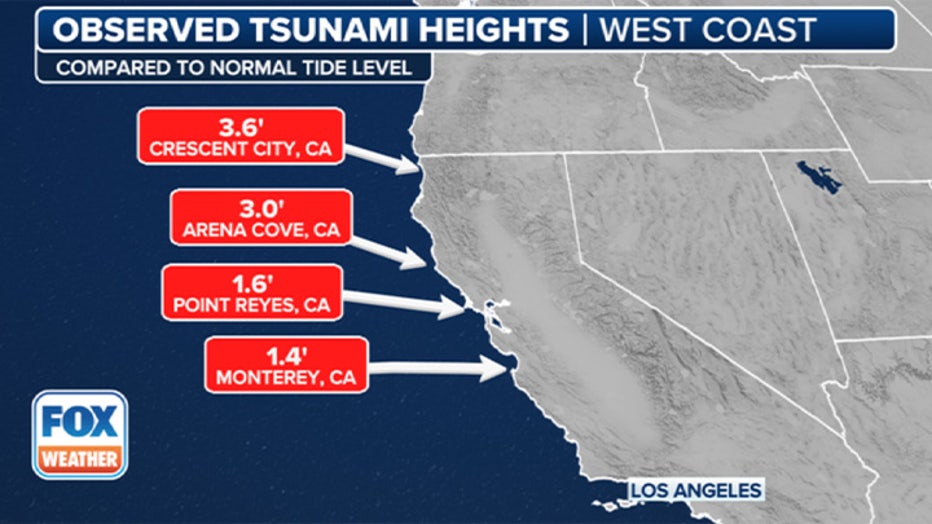
In addition, tsunami waves reached the La Jolla shoreline in San Diego County. "The first waves haven’t been the biggest with the arrival of additional waves for 6 or more hours after the initial waves," the National Weather Service said on X early Wednesday.
In another post, NWS explained, "The Tsunami Advisory is still in effect for all of our coasts. However, we are expecting very isolated low end warning level tsunami conditions for portions of coastal Port San Luis including Avila Beach. Stay away from beaches, harbors & coastal roads."
The Source: FOX Weather contributed to this report. This story also used information provided by the National Weather Service.