

NASA's Nancy Grace Roman telescope launches: What will it do?
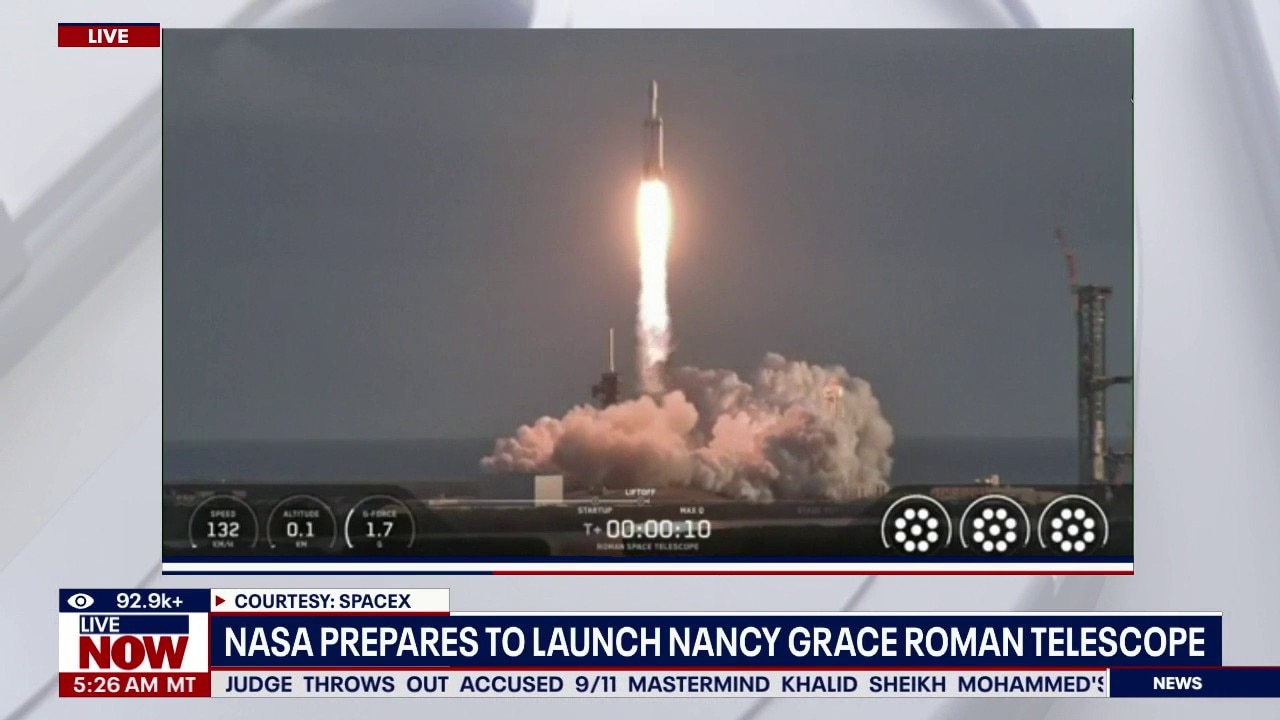
NASA Successfully launches Nancy Grace Roman telescope
NASA’s newest crown jewel blasted off Sunday to hunt for planets around other stars, explore secret dark energy and survey the cosmos like never before.
The Nancy Grace Roman telescope, NASA’s newest crown jewel, launched into space Sunday in search of new planets, dark energy and "the weird, the rare and the unusual."
The Roman telescope launched from the Kennedy Space Center in Florida Sunday morning aboard a SpaceX Falcon Heavy rocket. Here’s what to know:
What is the Nancy Grace Roman telescope?
By the numbers:
The telescope is the size of a bus and cost $4.3 billion to build. Its field of view is over 100 times wider than that of NASA’s Hubble Space Telescope, which has been in orbit for 36 years. A month of Milky Way observations by Roman would take Hubble a century to complete, NASA scientists say. Roman’s infrared camera is 1,000 times faster than Hubble’s.
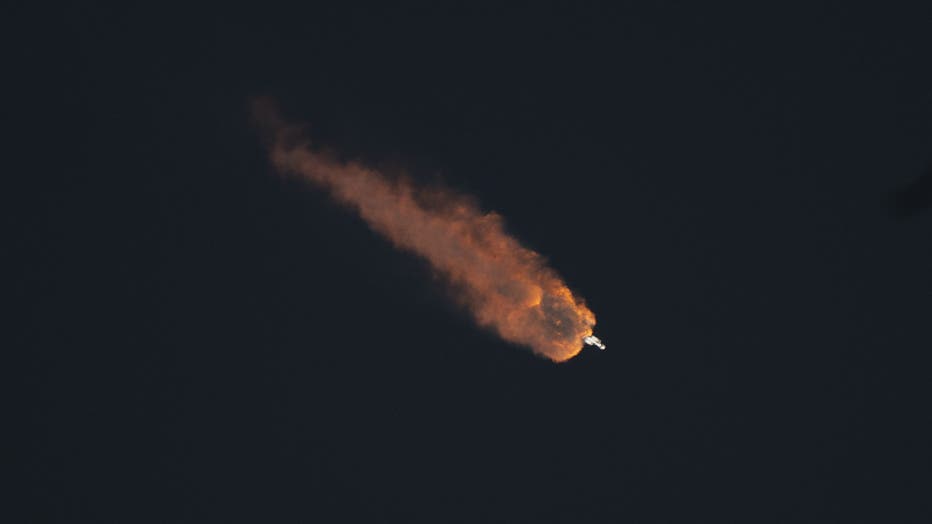
In this NASA handout, a SpaceX Falcon Heavy rocket launches with NASA'S Nancy Grace Roman Space Telescope onboard from Launch Complex 39A, on August 30, 2026, at NASA's Kennedy Space Center in Florida. (Photo by Joel Kowsky/NASA via Getty Images)
What will the Nancy Grace Roman telescope do?
Big picture view:
The Roman telescope, formerly called the Wide Field Infrared Survey Telescope (WFIRST), will help scientists study the universe like never before.
It will perform surveys of the galaxies to see the effects of dark matter and it will search for and study exoplanets—planets beyond our solar system. Once these new worlds are spotted by Roman, the more powerful and sensitive Webb will take aim to fill in the blanks.
RELATED: Life on the moon? NASA unveils its 3-phase plan timeline to build a permanent moon base
Roman also holds an instrument to block out starlight. This experimental, eclipse-creating coronagraph will allow Roman to directly image any planet, however faint, that might be orbiting the masked star.
Dig deeper:
Scientists hope the data collected by Roman will help answer questions about exoplanets and dark energy.
What they're saying:
"Roman’s vast reach will allow us to find the weird, the rare and the unusual," senior project scientist Julie McEnery said on the eve of launch. "We’ll redefine what it means to find a needle in a haystack."
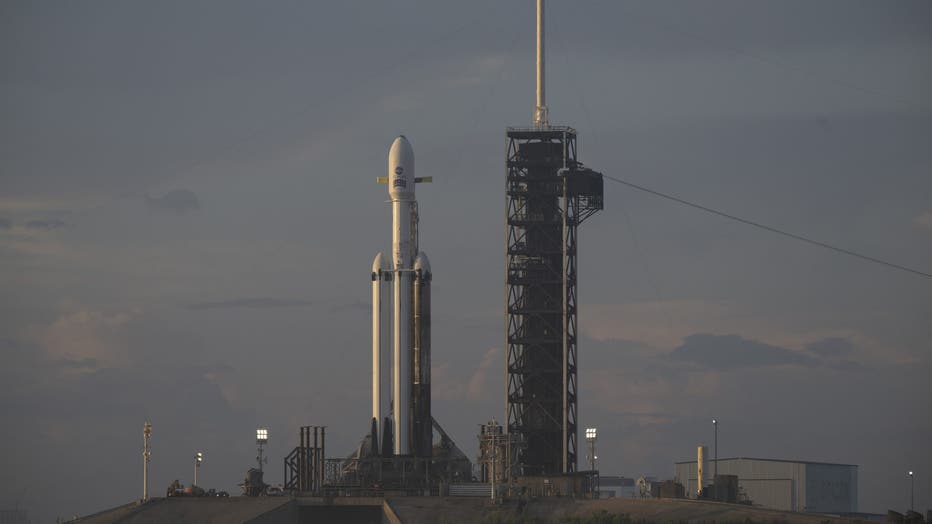
In this NASA handout, NASA's Nancy Grace Roman Space Telescope, encapsulated in a protective payload fairing atop a SpaceX Falcon Heavy rocket, is seen at sunrise on August 29, 2026, at Launch Complex 39A at NASA's Kennedy Space Center in Cape Canave
"It’s going to find thousands of supernovae, tens of thousands of planets, billions of galaxies and tens of billions of stars," NASA science mission director Nicky Fox said. "It’s going to be able to do things that we’ve never been able to do before with its massive field of view."
"Its crisp, sweeping survey will help scientists investigate dark energy and dark matter, discover and characterize exoplanets, map billions of galaxies, study black holes, and explore objects from our own solar system to the edge of the observable universe," NASA said in a blog post.
How long will the telescope be in space?
Timeline:
NASA says it’ll take more than three months for Roman to reach its destination – an observation point 1 million miles away that's also home to the Webb Space Telescope.
NASA plans for Roman to have a primary mission lifetime of five years, but it was designed to support a five-year extension.
Who was Nancy Grace Roman?
The backstory:
The telescope is named after Nancy Grace Roman, known as a pioneer of modern space-based astronomy. Roman was the first woman to hold an executive position at NASA and served as the agency's first chief of astronomy in the Office of Space Science. She was also known as the "mother of the Hubble Space Telescope" for her work in the planning and development of the telescope.
Roman died in 2018 at the age of 93.
The Source: This article includes information from NASA, The Associated Press, and previous FOX Local reporting. FOX 35 Orlando contributed.