

Armenian illumination from manuscripts to Glendale murals
GLENDALE, Calif. - In Glendale, art can meet you at the curb. It can wrap a utility box in color. It can turn a crosswalk into pattern and memory. It can rise across a church wall in saints, scripture and gold.
For artist Arpine Shakhbandaryan, those public works grow from a much older source, the Armenian tradition of illuminated manuscripts, a form she has spent years studying, practicing and translating into the life of a modern city.
Her path began with encouragement at Glendale High School, where a teacher saw her ability early. "She actually told me that I had a talent for art," Shakhbandaryan says. That push led her to private lessons in Glendale at the Atanian Art Center, where another decisive moment followed.
"He introduced me to the Armenian illuminated manuscript art," she says of artist and teacher Vladimir Atanian. "He gave me my first gold leaf. And that’s where I created one of my well-known pieces, which is Saint Etchmiadzin. So, it really started from there."
The art form she embraced reaches back centuries. Armenian illuminated manuscripts date to the fifth century, the Golden Age of Armenian literature, when artists created miniature illustrations, decorated initials and ornate borders around Gospel texts and other works.
Shakhbandaryan has drawn that language into the present through paintings, commissions, calligraphy and public art. Her work includes trchnakir, or bird letters, a traditional Armenian style in which letters take the shape of birds.
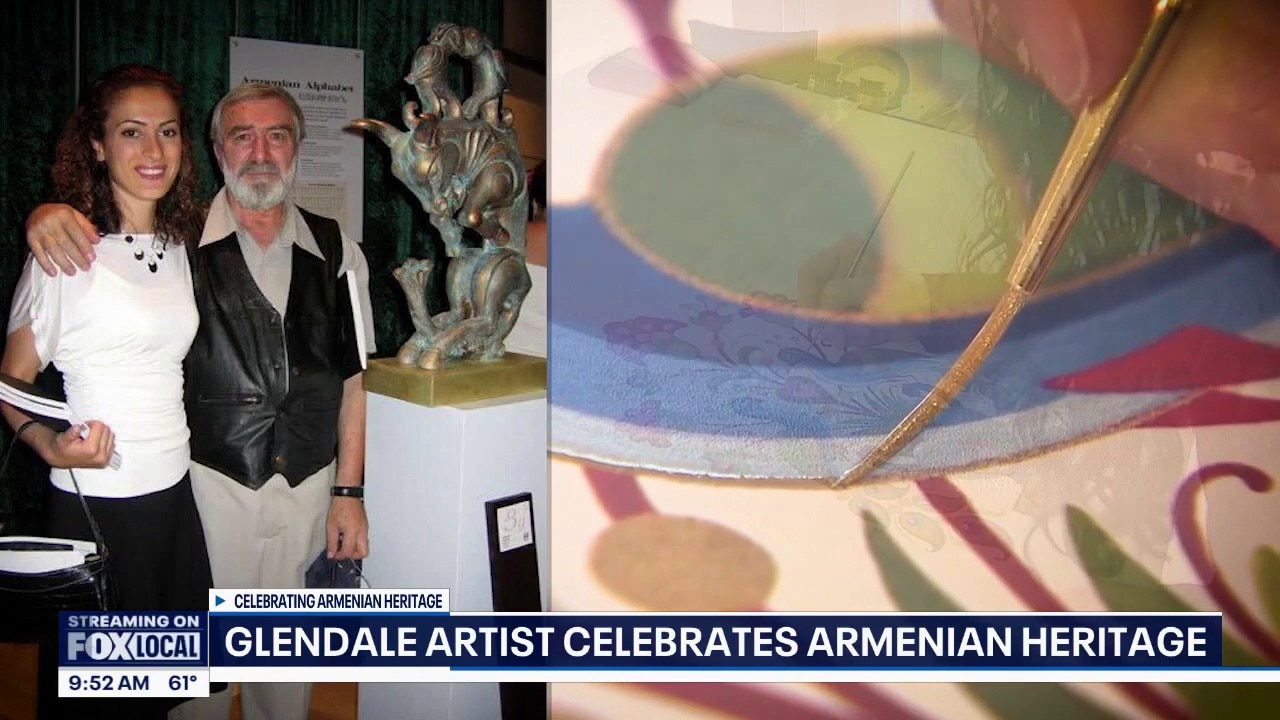
She describes the process with the care of someone who knows every step by touch. "To illuminate is to adorn with gold leaf," she says. "The work starts first with the pencil drawing. Then I apply special leaf glue with a paintbrush to the areas that will be golden. Then comes the process called gilding, applying the thin sheet of foil to the surface. This must be done carefully and gently." After the gold leaf is applied, the excess is brushed away, leaving the luminous surface that gives the work its glow. Then the rest of the painting takes shape in watercolor.
For Shakhbandaryan, illumination carries spiritual weight as well as beauty. Much of her work reflects Armenian history, churches, the Armenian alphabet and the homeland itself. "My faith is the foundation of my work," she says. "My art is a gift and blessing from God. Through my work, I want others to see the beauty and love He is creating all around us."
She first painted in this style at 18, choosing the Armenian alphabet for her first illumination. "I asked Professor Atanian how to do the gold technique," she says. "When he gave me the glue, gold, and a very fine brush, I felt privileged and honored." She later studied books on Armenian manuscripts from the seventh through 12th centuries and visited museums in Los Angeles to study illuminations in person.
Her formal education widened her range. At the University of Southern California, she worked in oil, acrylic and other media, and later earned a degree in biology with a minor in fine arts before continuing into graduate study in public health. Still, she kept returning to illuminated manuscript art.
"I did do oil, acrylic, and other forms of art in college," she says. "I went to USC and I was able to experiment with different forms, but my passion and the one that I continue to refine and continue to work on is the illuminated manuscript style." She adds, "I am drawn to the detail. The letters initially, the alphabet letters, you can manipulate them in many ways."
That sense of movement and possibility helps explain why the form travels so naturally through her public work.
Over the past two decades, Shakhbandaryan has contributed to eight public art projects, seven of them in Glendale, including a large mural, five utility box designs and a creative crosswalk installation. The city’s arts and public works programs created openings for artists to turn everyday surfaces into shared visual space. Shakhbandaryan says that work matters because it reaches people where they live.
"It’s bringing people together and bringing different art forms together," she says. "That’s why I really love applying for those public artworks."
She still remembers the excitement when Glendale first opened the utility box program. "They told me we’re going to celebrate the city of Glendale, and we’re going to let you paint the utility boxes; and you can do whatever you want as long as it’s celebrating the city of Glendale," she says. That invitation helped place her work in corners of the city where residents pass it on errands, on walks and on the way home.
One of her best-known pieces, "Glendale in Bloom," turns a utility box into a bouquet built from civic symbols and sister city ties. The design includes the Glendale hibiscus, the California poppy and the American rose, alongside the forget me not of Armenia, the Bayahibe rose of the Dominican Republic, the cherry blossom of Japan, the dahlia of Mexico, the jasmine of the Philippines and the hibiscus of South Korea. Jacaranda branches and peacocks tie the piece back to Glendale.
Shakhbandaryan describes the work almost as if she is arranging the bouquet in real time: "All of these flowers are coming together in this bouquet. And there’s the jacaranda branches, which is the official City of Glendale tree, and the peacocks are sitting on the branches, and it’s just wrapping around the utility box."
Another public piece reaches deeper into her own family history. Her "Jewel City Rug" crosswalk on West Broadway draws from Armenian rug design and from an heirloom woven by her grandmother nearly a century ago.
"I love rugs," she says. "It’s very an ancient form of not only for homes as a functional item, but it also tells stories. Rugs were used to weave community stories."
She connects that tradition directly to her family. "My grandmother, Aghafni Shakwandarian, she wove a rug. So now being 100 years ago, that I have. It’s an heirloom that my father passed on to me. And I wanted to kind of tell the story of Glendale in that form. I wanted it to be art. I wanted two symbols to be geometric. But I also wanted the rug feeling to come through."
That impulse, to place inherited memory in public view, also shapes her largest work. At St. Peter Armenian Church and Youth Ministries Center, she completed a mural of roughly 1,000 square feet that took months of sustained labor.
The mural includes St. Peter with his keys, Saints Hripsime and Gayane, the cathedral of St. Gayane, angels, the Holy Spirit as a dove, Jesus walking with an Armenian family, and the tree of life and knowledge rendered in illuminated manuscript style.
"The mural represents the story of love," she says. "Jesus taught love to his disciples. That message passed through St. Peter, then to St. Hripsime and St. Gayane, and ultimately to the Armenian people."
She speaks about the labor in plain terms. "I worked on it for six months, for day and night," she says. "Probably I would say six days out of the week, I took a break on Sunday service. And it was completed."
Throughout her work, Shakhbandaryan returns to the same idea: joy shared in public becomes a form of connection. "If it brings them joy, when the artwork brings them joy, they celebrate together," she says. "And that’s part of being together."
In Glendale, that feeling lives on walls, sidewalks and street corners. Ancient Armenian forms move through a modern city. Gold leaf still catches the light. And Shakhbandaryan’s work gives that light a place to land.