

Riverside County to vote on localized reopening plan

Riverside County to vote on localized reopening plan
The Riverside County Board of Supervisors was set to vote on a localized reopening plan on Oct.6.
RIVERSIDE, Calif. - The Riverside County Board of Supervisors Tuesday will revisit a proposed accelerated public health de-regulation plan to allow all Riverside County economic sectors to reopen by the end of this month, bypassing the state's tiered system to mitigate coronavirus impacts, which Executive Office staff said could come at a cost of $100 million in money otherwise due to the county.
Currently, Riverside County is in the red tier, and is subject to the state’s Blueprint for a Safer Economy- a four-tiered system that loosens business restrictions as COVID-19 case rates and positive test rates decline.
The proposal introduced by Supervisor Jeff Hewitt would give the nation’s 10th largest county the power to decide when and how to reopen businesses.
"We're going to be operating in an economy that's going to be crushed. We need to move forward on this and stop putting it off," Hewitt said, venting frustration at the governor's and California Department of Public Health's changes to reopening formulas since March.
Supervisors Karen Spiegel and Kevin Jeffries expressed support for the concept but requested a delay in voting until today to give the ExecutiveOffice time to evaluate the potential funding losses that might ensue if the state frowns on the county's autonomous initiative and ignores the color-coded tiered structure.
"Public health officers should not be dictating the terms and conditions of our fundamental rights," Jeffries said. "When I had pneumonia a few years ago, I did not turn over my business and livelihood to my physician. Only the businesses and residents of this county can open it again.''
However, under Hewitt's plan, which mirrors the Community Action Plan that the county submitted to the state in August, the state's next two tiers -- the orange and green -- would be replaced with a county-designed two phase system, which would begin on Oct. 13.
RELATED: Riverside County supervisor seeks to expedite lifting of COVID-19 shutdowns
Under Phase II, limited indoor activities would be permitted for all dining establishments, cultural celebrations and weddings, but they would be capped at 25% capacity, or 100-person attendance, whichever is less. Phase III would follow on Oct. 27, with bars, breweries, wineries, "non-essential" offices and family entertainment centers permitted to operate with safety measures in place.
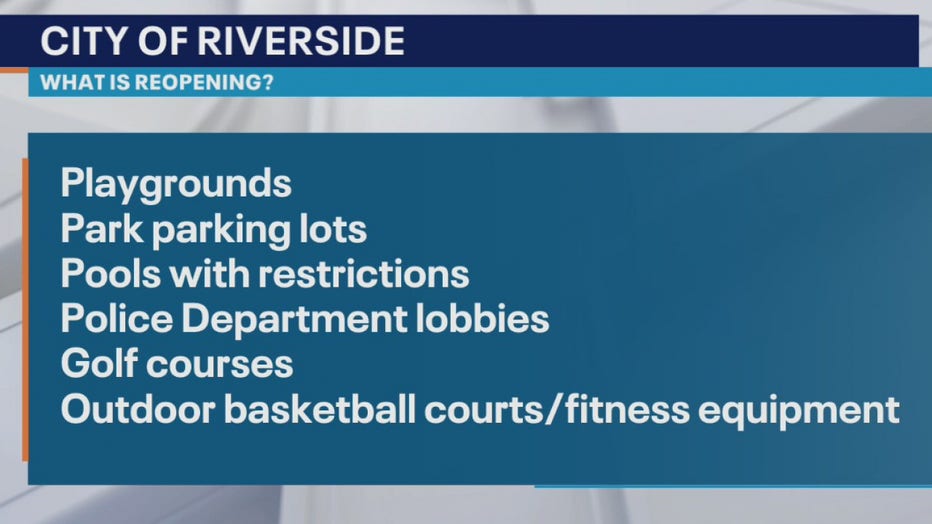
Also, according to the Office of the City Manager, the One Stop Shop in City Hall at 3900 Main St. will be available from 10 a.m.-2 p.m. daily, beginning Tuesday. The facility aids with commercial and residential development applications.
In-person council meetings will also resume Tuesday afternoon on the third floor of City Hall.
The city will continue to allow residents who prefer not to attend in person to participate virtually via EngageRiverside.com.
The governor's office deferred to the CDPH for a response to Hewitt's proposal, and agency spokesman Ali Bay said that the state is wedded to the tiered system, which only permits jurisdictions to "impose policies that are more strict than the state's blueprint," not recognizing an independent relaxation of restrictions.
Supervisors Manuel Perez and Chuck Washington oppose Hewitt's concept, saying there's too much at risk for the county to divorce itself from the state's directives.
According to the Executive Office, the county may stand to lose $114 million in allocations due from the state, including money for the Homekey homeless mitigation programs and additional federal Coronavirus Aid, Relief & Economic Security Act funding. However, that was a best guess projection, meaning it could be more or less -- or nothing at all.
The county plan would be administered by CEO George Johnson, who would make final determinations on the pace of the phased reopening, depending on whether COVID-19 infections tick up, remain flat or decline.
RELATED: Stay up to date on all coronavirus-related information
During the first hearing on Hewitt's proposal, more than 70 people spoke, overwhelmingly in favor of booting the state's tiered system and immediately abolishing public health lockdowns.
"A quarantine is to isolate people who are sick," John Hussey of Riverside said. "But what they're doing is isolating everybody and punishing business people."
Several ministers and nonprofit supporters pointed out that food banks and other charities are struggling to keep up with the demand for supplies from people thrown out of work by the state's lockdowns. Speakers also stressed that suicides, suicide attempts, depression, child abuse and other ramifications were attributable to the government-mandated changes in society.
Hewitt's original plan centered on allowing a coronavirus testing positivity rate up to 14%, and anything above that would warrant returning to increased health regulations. According to the most recent California Department of Public Health data, the number of screenings that reflect positive tests for COVID-19 countywide is around 6%.
Get your top stories delivered daily! Sign up for FOX 11’s Fast 5 newsletter. And, get breaking news alerts in the FOX 11 News app. Download for iOS or Android.