

Legal showdown: Newsom vs. Trump over the militarization of National Guard

Hearing on Trump's use of National Guard, Marines
As anti-ICE protests happening nationwide, President Donald Trump and California will face off in court Thursday.
The legal showdown between California Gov. Gavin Newsom and President Donald Trump takes center stage Thursday afternoon in a federal courtroom in San Francisco.
The issue: Does Trump have the legal authority to send in the California National Guard and U.S. Marines to quell the anti-ICE protests in Los Angeles without the consent of the governor?
Newsom says no.
He filed a lawsuit this week, arguing that Trump does not have the constitutional power to federalize the military without his consent and coordination.
Trump said he indeed has the power to call in the military to protect federal buildings, property and personnel.
Each side will be making their arguments before U.S. District Judge Charles Breyer, 83, a former Watergate prosecutor nominated to the bench by Bill Clinton in 1997 and whose brother, Stephen Breyer, retired from the U.S. Supreme Court in 2022.
Breyer is being asked to decide whether Trump has the legal authority to federalize 4,000 California National Guard troops to Los Angeles without the governor's consent.
Breyer could take immediate action or he could take some time before deciding whether to grant the temporary restraining order, called a TRO.
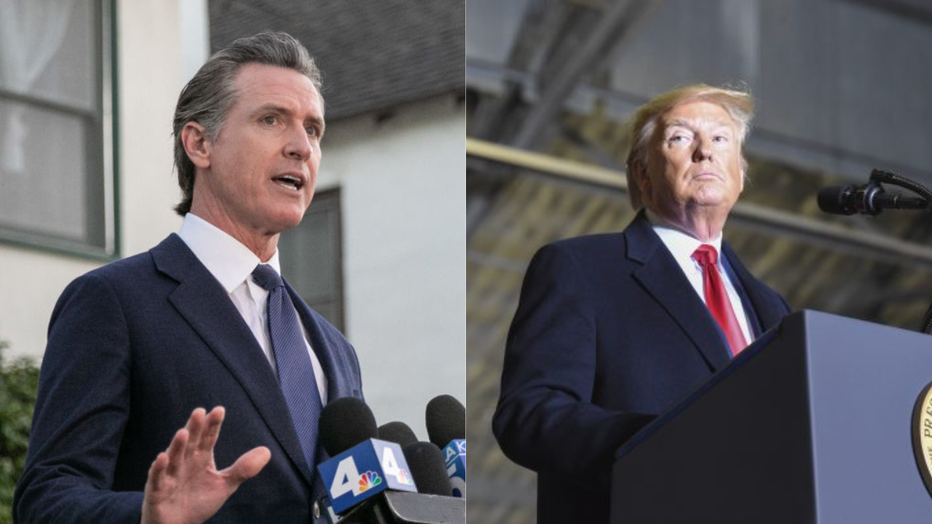
Newsom's argument
Newsom argued in a 22-page lawsuit against President Donald Trump and Secretary of Defense Pete Hegseth that the president has invoked emergency powers to "exceeds the bounds of lawful executive authority," and that Americans should be governed by civil, not military rule.
Newsom and California Attorney General Rob Bonta wrote to the court that Trump had wrongly invoked something called Title 10 to send in 4,000 California National Guard troops to Los Angeles after protests broke out there, some of which got destructive, to quell the crowds. And in fact, Newsom's team argued, it was the federal ICE agents who inflamed tensions, not the protesters.
While there have been some pockets of protester unrest, Newsom's team wrote: "At no point in the past three days has there been a rebellion or insurrection."
Nor have the protests risen to the level of protests or riots that Los Angeles and other major cities have seen at points in the past, they argued.
The last time the National Guard was federalized for riot control was in 1992 – at the governor's request – during the Rodney King riots.
Newsom and Bonta called this an "unprecedented usurpation of state authority." And their legal argument centers on the fact that the president's "federalization and deployment" of the National Guard for "reasons not authorized by law and without input or consent from the governor contravenes core statutory and constitutional restrictions."
The Constitution, they argue, reserves the right of states to determine when to bring in the military, unless the state requests or consents to federal control.
"Only under the most exigent of circumstances can the president, over the objections of a state," call the National Guard into federal service, Newsom's team said. This how the only way to check "federal overreach," they argued.

Is California's move to block the National Guard a political stunt?
Is California's move to block the National Guard a political stunt? That's what President Trump called Gov. Gavin Newsom's move to block the federalization of the National Guard.
Trump's argument
Trump is being represented by Asst. Attorney General Brett Shumate, and other members of the Department of Justice, Eric Hamilton, Alexander Haas, Christopher Edelman, Garry Hartlieb and Benjamin Kurland.
They argue that Newsom is engaging in a "crass political stunt endangering American lives," as he tries to stop the President of the United States from "exercising his lawful statutory and constitutional power to ensure that federal personnel and facilities are protected."
Trump's team said in a 59-page court filing filed Wednesday that the reason the president has the authority to bring in the National Guard is because there have been "violent rioters" in Los Angeles, who have vandalized buildings and property, and injured law enforcement officers, which the Los Angeles Police Department has not been able to quell.
Trump's legal team cited what LAPD Chief Jim McDonnell said at a news conference, where he told the public that "things have gotten out of control" and warned that "somebody could easily be killed."
Because of that, either that the local police were "unable or unwilling to control" the crowd, Trump responded by using the authority vested in him by statute and the Constitution to federalize and deploy the California National Guard to protect federal personnel and property, quell the mobs, and restore order," Trump's lawyers wrote to the judge.
Trump properly invoked his statutory authority to federalize the California National Guard, a sensitive judgment that the president holds by law and to "which the courts owe the highest deference."
The statute, technically called Title 10 USC 12406, empowers the president to determine what forces "he considers necessary to suppress a rebellion or to execute federal laws."
And in terms of the Marines and the National Guard, Trump's team said they are not engaged in law enforcement, rather than "protecting law enforcement."
And in fact, Trump's team wrote, Newsom has not provided any evidence otherwise, only a "speculative assertion" that both branches of the military "will be unused for unlawful purposes in the future."
Mayor of LA, California leaders call for end to ICE sweeps amid protests, military involvement
Mayor Karen Bass and other regional leaders are calling for ICE to end its sweeps and blasting the deployment of National Guard members and Marines in Los Angeles. Her call comes amid ongoing enforcement and protests.
Legal experts
UC College of the Law Professor David Levine told KTVU that the judge has a "very tricky" situation to decide.
And in the end, Levine guessed that the judge won't make either side completely happy.
"I think he's going to ask very skeptical questions of both sides," Levine said. "I think he's going to try and strike a middle path."
Politics outside the courtroom
The issue is playing out outside the courtroom as well.
Newsom has been making speeches and spoke to the New York Times podcast, the Daily, making his arguments. And the president has also been doing the same, telling reporters outside the Kennedy Center on Wednesday night that if he didn't send in the troops, Los Angeles would be "burning to the ground," and issuing statements on Truth Social, taking barbs at the governor.
For Trump, it’s another chance to battle with Newsom, a frequent foil who leads a heavily Democratic state the president has long criticized.
And for Newsom, the feud has handed him a national platform as a beleaguered Democratic Party seeks a leader able to resist Trump.