

ICE body camera policy allows video releases only in agency's 'best interest'
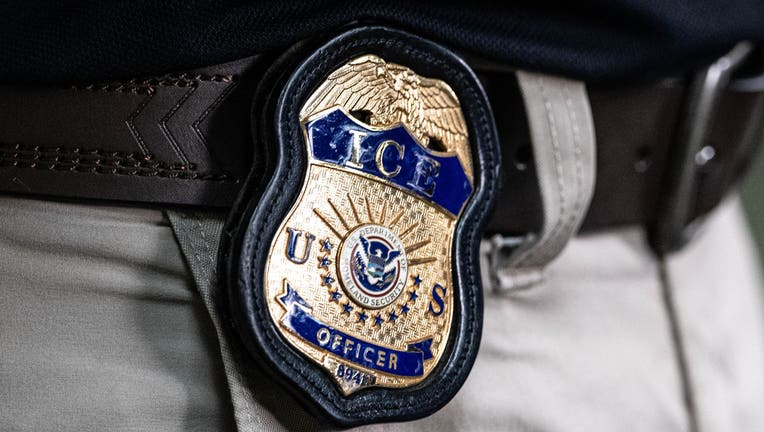
An ICE deportation officer's badge in Dallas, Monday, June 1, 2026. (Angela Piazza/The Dallas Morning News via Getty Images)
Body worn cameras are coming to Immigration and Customs Enforcement officers within the next two months. But there may be some lingering issues surrounding transparency and the public having access to their video for some of their most volatile incidents.
ICE’s directive on body worn cameras has a specific qualification for the release of their video that captures the event of an in-custody death or serious body injury, that the agency will review to determine if the release is ‘in the best interests of the agency’ before it is released publicly.
What they're saying:
That policy gives the agency discretion to decide whether a video reflects well on its image without having to feign transparency, according to some experts. Christopher Schneider of Brandon University in Canada says ICE is saying out loud what some law enforcement agencies only state implicitly.
"Body-worn cameras are being used as contemporary image-work tools to present the police to the public in the most favorable way possible," Schneider says.
The ICE body worn camera policy
The U.S. Immigration and Customs Enforcement body worn camera policy was adopted in February 2025. It requires officers to activate cameras during enforcement, including making arrests and serving search warrants.
Incidents where an officer fires a weapon or other serious confrontations, top ICE officers will review to recommend whether it should be released expeditiously or not.
In the event a Serious Bodily Injury or Death in Custody is captured by a BWC, ICE will expeditiously review the footage. If it is determined that it is in the best interests of the agency to publicly release the BWC footage, ICE will, as soon as practicable, expedite the public release of such footage. Generally, this process should occur within 72 hours of recording of a Serious Bodily Injury or Death in Custody, or as soon as operationally feasible. If there are specific and compelling circumstances justifying an objection to public release that cannot be resolved by redaction or other means, when determined by the ICE Director or his or her designee, ICE may withhold or indefinitely delay the release of the BWC footage.
RELATED: ICE officers to wear body cams during vehicle stops
Recent shootings involving ICE officers
The backstory:
ICE officers shot and killed a motorist in Maine on July 13. The victim was not the target of the warrant the officers were executing, Sen. Angus King said Homeland Security Secretary Mullin told him. The officer opened fire after the man tried to use his vehicle as a weapon against officers who were pursuing him in Biddeford.
The backstory:
On Tuesday, July 7, in Houston, Lorenzo Salgado Araujo was shot and killed by an ICE officer. ICE says agents were attempting to stop Salgado Araujo as part of what they described as a targeted enforcement operation. ICE officers say Salgado Araujo, who did not have legal permission to be in the United States, rammed an ICE vehicle, ignored verbal commands and attempted to run over an officer.
Dig deeper:
In 2024, a body camera pilot program was deployed to ICE officers in just five cities: Baltimore, Buffalo, Detroit, Philadelphia and Washington, D.C.
Following the high-profile deaths of two people in Minnesota that led to nationwide protests, former Department of Homeland Security chief Kristi Noem said the body camera program would be rolled out to ICE agents as funding becomes available.
The Source: This story was written with information provided by The Associated Press and U.S. Immigration and Customs Enforcement. This story was reported from Orlando.