

California High-Speed Rail Authority CEO Ian Choudri resigns amid wasteful spending audit: report

PREVIOUS COVERAGE: CA high-speed rail spent $600K on improper expenses
The audit, released Tuesday by the California Office of the Inspector General (OIG), revealed that taxpayers footed the bill for private aircraft travel, tiki bar visits, cigar lounges, luxury rideshares and international trips over a two-year period.
LOS ANGELES - The chief executive of California’s embattled high-speed rail authority abruptly stepped down this week, ending a turbulent two-year tenure defined by escalating budget crises and improper spending, CalMatters reports.
What we know:
The California High-Speed Rail Authority board of directors confirmed the departure of Chief Executive Officer Ian Choudri during a meeting in Anaheim following initial reporting by CalMatters.
Choudri, who was appointed to lead the state agency in August 2024 with an annual compensation package exceeding $534,000, had faced mounting pressure over both operational delays and executive management.
Board Chair Steve Kawa formally acknowledged the transition, offering public thanks for Choudri's service to the state program.
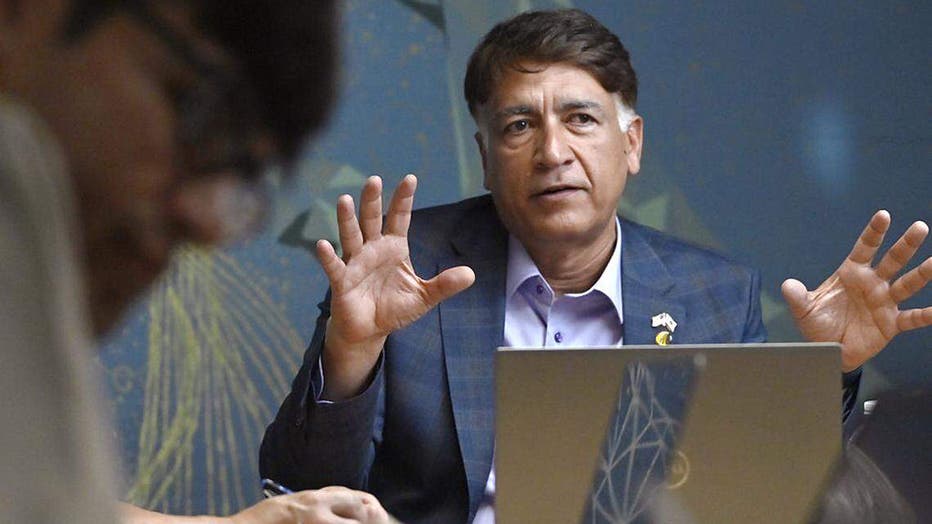
California High Speed Rail CEO Ian Choudri is interviewed by the California McClatchy Editorial Board Wednesday, July 30, 2025, in Fresno, California. (Eric Paul Zamora/The Fresno Bee/Tribune News Service via Getty Images)
"We thank Mr. Choudri for his service and his contributions to the high speed rail program, and we wish him and his family well," Kawa said in a statement.
Choudri stepped down just as the board was scheduled to evaluate whether his performance warranted a $25,000 annual bonus, according to CalMatters.
Dig deeper:
Choudri’s resignation arrived on the heels of a damning September report issued by the authority’s Office of the Inspector General detailing systematic compliance failures in travel expense reimbursements.
PREVIOUS COVERAGE:
- California high-speed rail could run out of money by 2027, inspector general warns
- California high-speed rail costs soar to $230 billion
Auditors reviewed approximately half of the $2 million spent across four private consulting firms over the past two fiscal years, discovering that $680,500—roughly 60% of reviewed expenditures—constituted unapproved or unallowable spending.
State-funded reimbursements included rideshares to an escape room, private residences, Planet Fitness gyms, a tiki bar, a cigar lounge in Washington, D.C., and upscale dining establishments across multiple states, according to the report.

California high-speed rail could run out of money by December 2027
The High-Speed Rail Authority "will exhaust its current funding resources as soon as December 2027 if it does not secure financing," Inspector General Ben Belnap's office found, warning the authority faces a $9.5 billion funding gap over five years.
The administrative fallout compounding Choudri's tenure included severe federal financing cuts, marked by the Trump administration rescinding $4 billion in grant funds in July 2025.
Additionally, the inspector general found that current cost projections omit a $1.2 billion gap in default-level contingency budgets, $816 million in construction costs expected to be covered by third parties, and $1.7 billion for required infrastructure under existing local agreements that project leaders hope to modify.
What we don't know:
The transit authority has not yet named an interim or permanent successor to assume the chief executive duties.
State officials have not determined how the agency will bridge its looming financial deficits after Belnap warned the venture could exhaust available cash reserves within the coming year.
What they're saying:
State Senator Tony Strickland, a Republican member of the Senate Transportation Committee, criticized the project's repeated leadership turnover.
"The California High-Speed Rail Authority has had four CEOs since 2010, including Ian Choudri, appointed in 2024. Instead of reshuffling the chairs on the Titanic, it’s time to pull the plug on the high-speed fail and deliver immediate relief to struggling Californians paying the nation’s highest gas taxes. Californians deserve accountability, not another revolving door of leadership," he said in a statement.
Big picture view:
California's high-speed rail project was officially launched by voters in 2008 through Proposition 1A, which approved nearly $10 billion in bond funding for a 220 mph electrified bullet train designed to link Los Angeles to San Francisco in just under three hours.
In the years since, the mega-project has been severely beleaguered by bureaucratic delays, land-acquisition fights, leadership churn, and ballooning cost projections – surpassing $100 billion for the full statewide system compared to initial estimates.
To demonstrate viable progress, the state scaled back its near-term ambitions to focus on completing an initial 171-mile operating segment through the Central Valley between Merced and Bakersfield.
Today, civil construction is advancing across more than 100 miles of central spine with passenger service targeted for the early 2030s; however, the project remains politically fraught, currently facing leadership transitions, audit scrutiny, and over agency spending, as well as a looming financial cliff after the loss of key federal funding.
What's next:
To address a cumulative $9.5 billion funding gap between fiscal years 2027–28 and 2031–32, officials are considering options such as internal state borrowing, revenue bonds, or private financing. However, borrowing will add between $3.6 billion and $6.6 billion in interest costs, which were excluded from the authority's official $35.7 billion estimate for the Central Valley line.
The Source: This article is based on public statements and official confirmations delivered by the California High-Speed Rail Authority board of directors and Board Chair Steve Kawa during their Anaheim public meeting, as well as published compliance reports from agency Inspector General Ben Belnap as reported by CalMatters. Direct commentary and policy reactions were drawn directly from statements released by California state legislators and agency spokespersons.